Industrial AI ≠ 'Large Model Competition', Gtrontec breaks through 'Collaboration of Large and Small Models'
Over the past year, generative AI and large model technologies have swept the globe with immense momentum, from large model dialogues to code generation agents. AI seems to have become omnipotent overnight. However, the complexity, diversity, and stringent requirements for stability and reliability in industrial scenarios make the implementation of industrial AI not a simple addition but a systematic transformation involving technology adaptation, model innovation, and ecosystem building.
Recently, the 'Industrial and AI Integration Application Guide' jointly compiled by China Academy of Information and Communications Technology, Tsinghua University Artificial Intelligence Research Institute, Roland Berger, and Huawei has sparked heated discussions in the industry. The 'double curve' characteristic of industrial AI applications mentioned in the guide accurately depicts the complex landscape of current manufacturing intelligence transformation. That is, general large models rapidly penetrate the R&D and marketing service ends first, while industrial small models are deeply cultivated in the production and manufacturing end first. This seemingly divergent integration path points to a core proposition: in the industrial field, the competition in AI is not simply moving large models into factories, but lies in building a model system that truly understands industrial scenarios.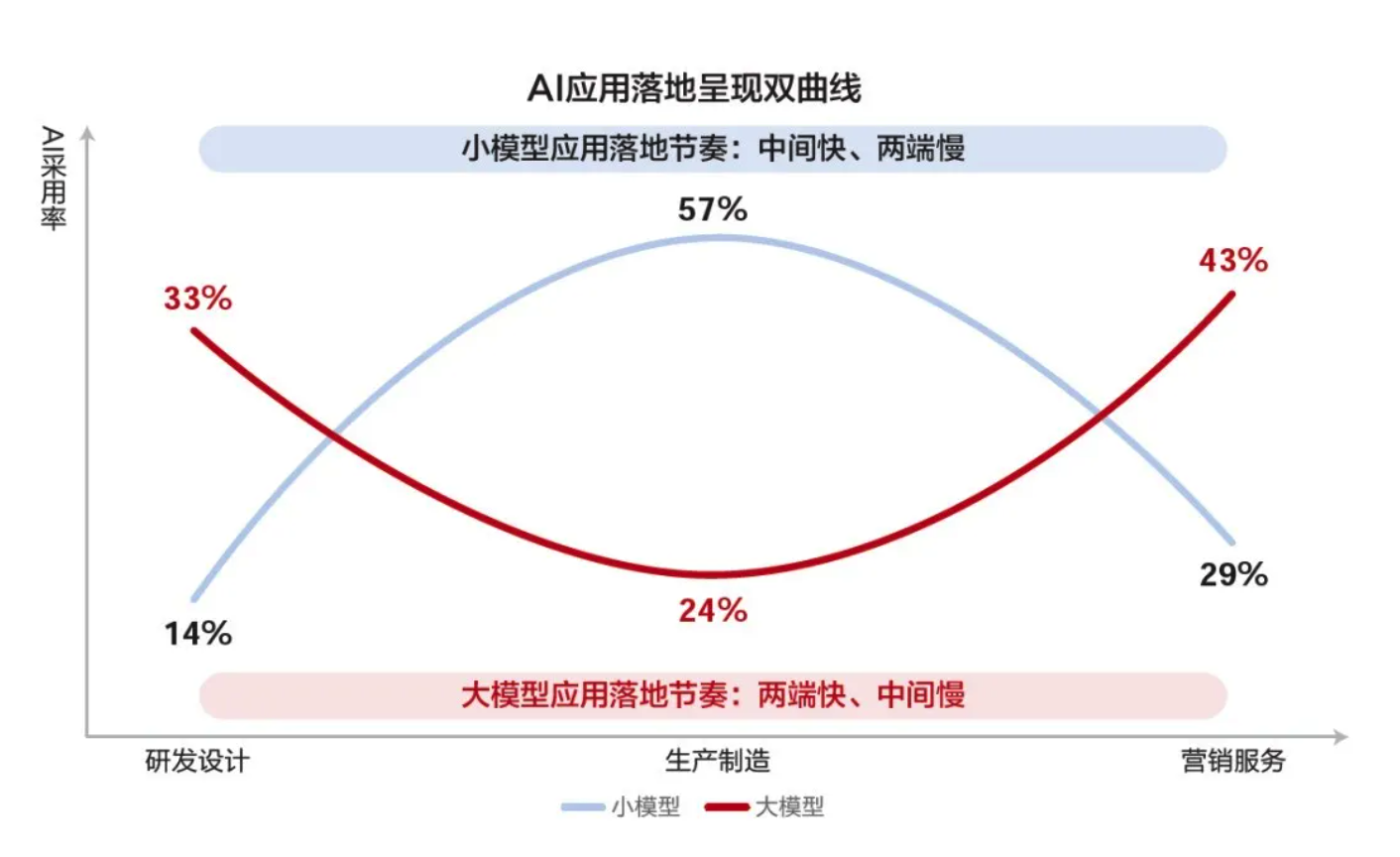
As a leading enterprise in the industrial AI field strategically incubated by TCL, Gtrontec has a deep understanding of this proposition and has long explored a path of 'collaboration of large and small models' for industrial AI implementation.
In practice, industrial manufacturing is a highly specialized, mechanism-driven field. The operational logic of production equipment over decades, complex physical and chemical reactions in process flows, and intricate causal relationships in quality control constitute the so-called industrial Know-How. This knowledge is highly structured, implicit, and full of causal logic, making it difficult to acquire by training general large models based on public internet data.
The 'Industrial and AI Integration Application Guide' also points out that although large models perform excellently in natural language understanding and content generation due to their vast parameter systems, their 'hallucination' risks, insufficient interpretability, and high computational costs make them less capable when facing production scenarios like equipment anomaly prediction and millisecond-level optimization of process parameters, where minor errors can lead to significant deviations. In contrast, industrial small models are mostly perception-based, discriminative models focused on specific scenarios, with higher specialization after long-term refinement of input-output relationships. IDC statistics also confirm this: currently, industrial AI small models account for up to 70% of applications.
Based on years of practice in intelligent manufacturing and industrial AI implementation, Gtrontec is well-versed in the division of labor and synergy of the 'collaboration of large and small models' path. In this system, large models take on enterprise-level cognition and decision-making capabilities. By understanding the enterprise knowledge system, business processes, and multi-source data, large models can achieve complex semantic understanding, cross-system knowledge reasoning, and intelligent decision generation. Small models, on the other hand, are deeply embedded in specific industrial scenarios, trained through industrial mechanisms and production data to form professional models for specific business links, such as equipment predictive maintenance models, quality defect identification models, process optimization models, and energy consumption analysis models.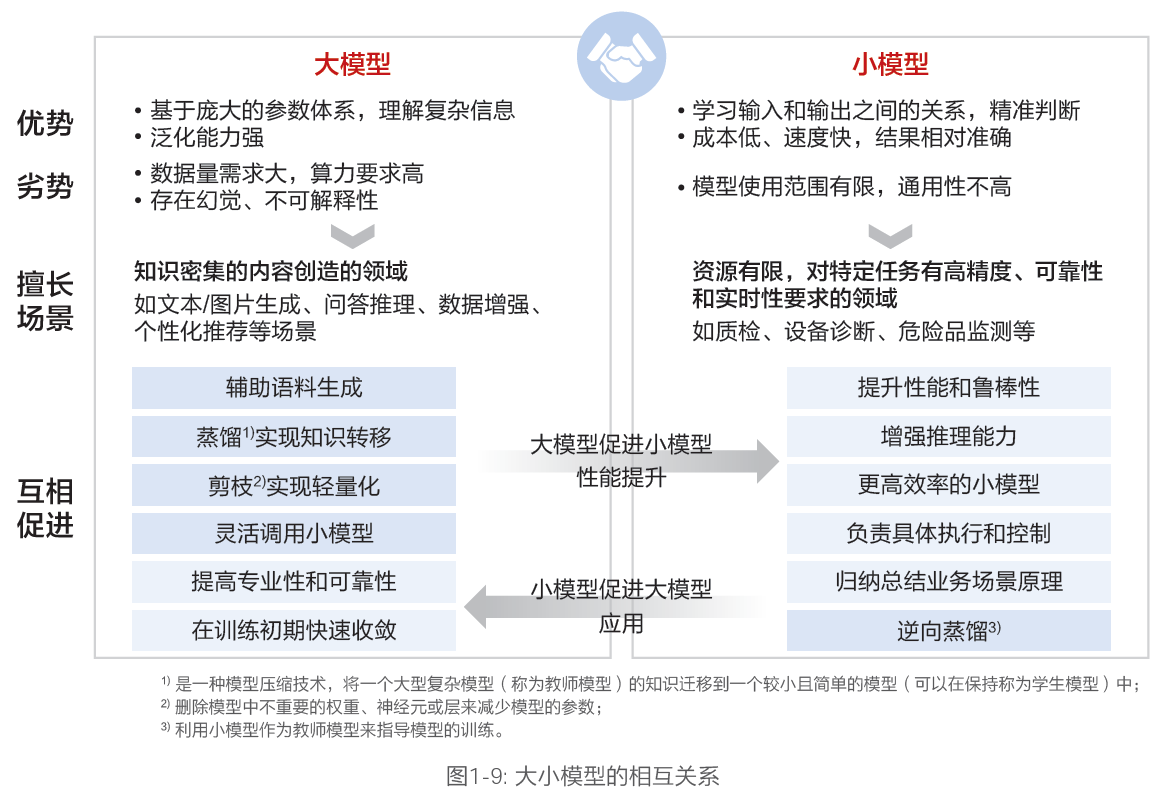
Through this collaborative model, large models are responsible for 'understanding and decision-making,' while small models handle 'perception and execution,' forming a complete closed loop from data insights to intelligent decisions.
Meanwhile, in Gtrontec's practice, industrial AI cannot truly deliver value without industrial software as the 'container,' as these systems accumulate core business data and production logic. Manufacturing enterprises have long relied on industrial software systems like MES, FDC, and QMS, accumulating large amounts of data and business models highly correlated with production operations. This data is not only an important foundation for AI training but also key to understanding industrial scenarios. Gtrontec's path is to deeply integrate AI capabilities with industrial software and intelligent equipment, enabling AI to continuously learn real data from the production process and optimize model capabilities, thereby forming a sustainable 'collaboration of large and small models' system that truly understands industrial scenarios. This model also makes AI more than just a data analysis tool, but one that can truly participate in enterprise production and operational decisions.
Notably, the value of this path has been verified in multiple high-standard manufacturing scenarios. In the 'Intelligent Equipment Operation and Inspection Assistant' project at TCL Huaxing, a large model was used to build a device fault handling assistant to help engineers quickly query knowledge and locate faults, combined with small models for real-time monitoring and early warning. After the project went online, it is expected to reduce fault duration by 241.4 hours per month, with an annual benefit of up to 30 million yuan. In the field of quality management, the 'Yield Analysis Agent' for frontline quality engineers can autonomously identify production anomalies, perform comprehensive reasoning based on historical quality data and process knowledge, and generate a complete analysis report within minutes, freeing engineers from tedious data processing and allowing them to focus on root cause analysis and improvement decisions. These cases clearly show that the value of industrial AI lies in transforming frontline data insights into actual business decisions through the collaboration of large and small models.
With the continuous integration of generative AI and intelligent manufacturing, the manufacturing industry is ushering in a new round of intelligent upgrading. The 'Industrial and AI Integration Application Guide' outlines macro trends for the industry, while frontline enterprises like Gtrontec are writing micro-practices through factory empowerment and offering insights: the core competitiveness of future industrial AI is not just model capabilities, but the understanding of industrial scenarios, the accumulation of industrial mechanisms, and the implementation ability to combine AI with systematic engineering.
What determines the height of industrial intelligence is who can provide an AI system that better understands factories. In this journey from 'data insights' to 'intelligent decisions,' only a system rooted in workshops, understanding processes, and collaborating large and small models can turn AI into a stable new quality productivity in factories.