From 'Seeing' to 'Action': Gtrontec Unlocks Industrial AI Decision Closed-Loop at IDC 2026 China CIO Summit
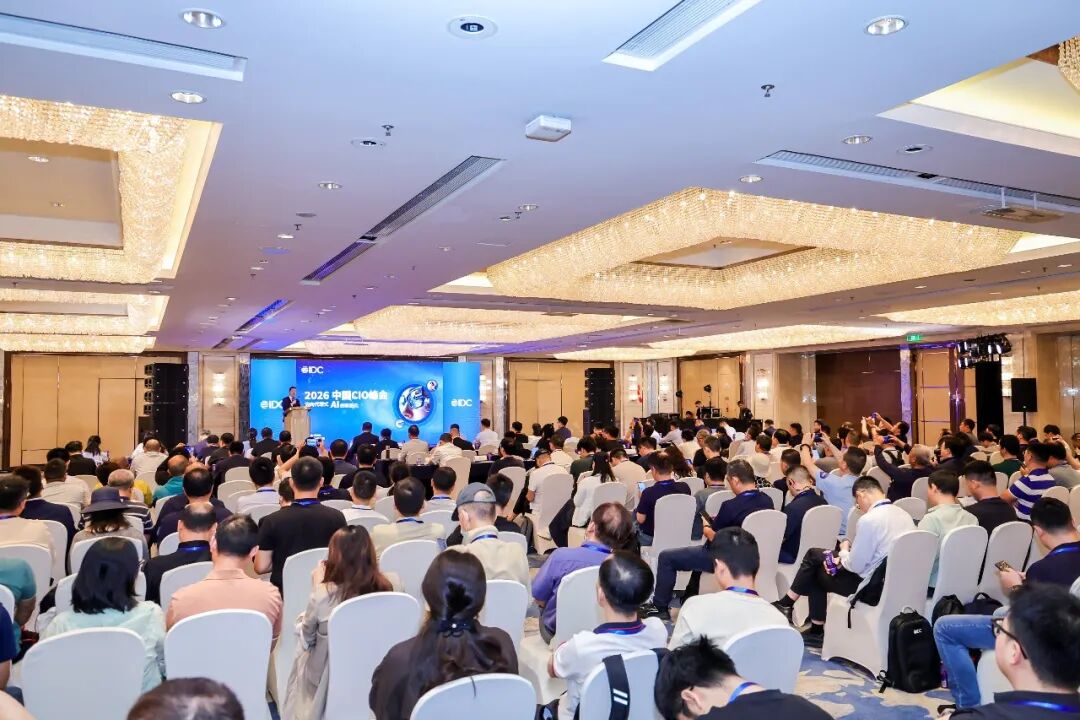
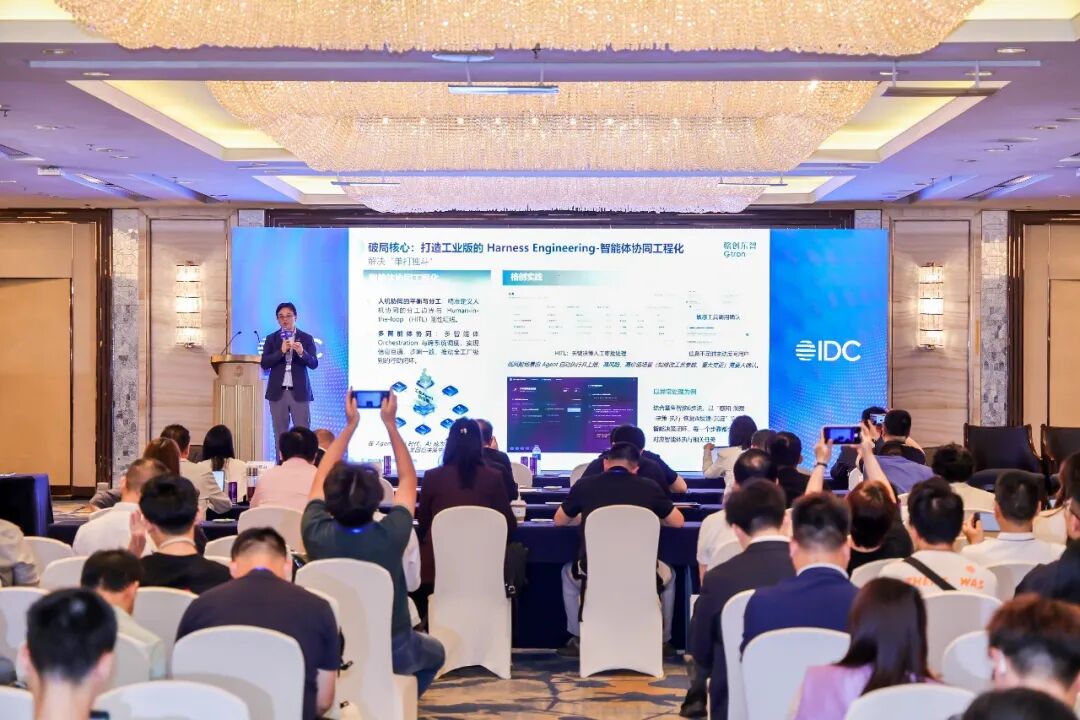
On May 15, the 2026 China CIO Summit hosted by IDC opened grandly in Shenzhen. TCL Industrial VP and Gtrontec CEO He Jun was invited to attend and deliver a keynote speech titled "From Seeing to Action: AI Creates a New Paradigm for Smart Manufacturing." Facing the most concerning question for manufacturing enterprises—"How can AI truly enter the core production process?"—He Jun presented a highly practical methodology around the engineering deployment of industrial AI, system collaboration, and organizational restructuring.
In the current AI boom in manufacturing, "being able to converse" is no longer rare, but "being able to execute" is the true dividing line. He Jun pointed out that industrial AI is transitioning from analytical AI and generative AI to agentic AI. In the past, AI mostly stayed at the level of "seeing problems." Today, manufacturing needs "action-oriented AI" that can autonomously perceive, analyze, decide, and execute tasks.
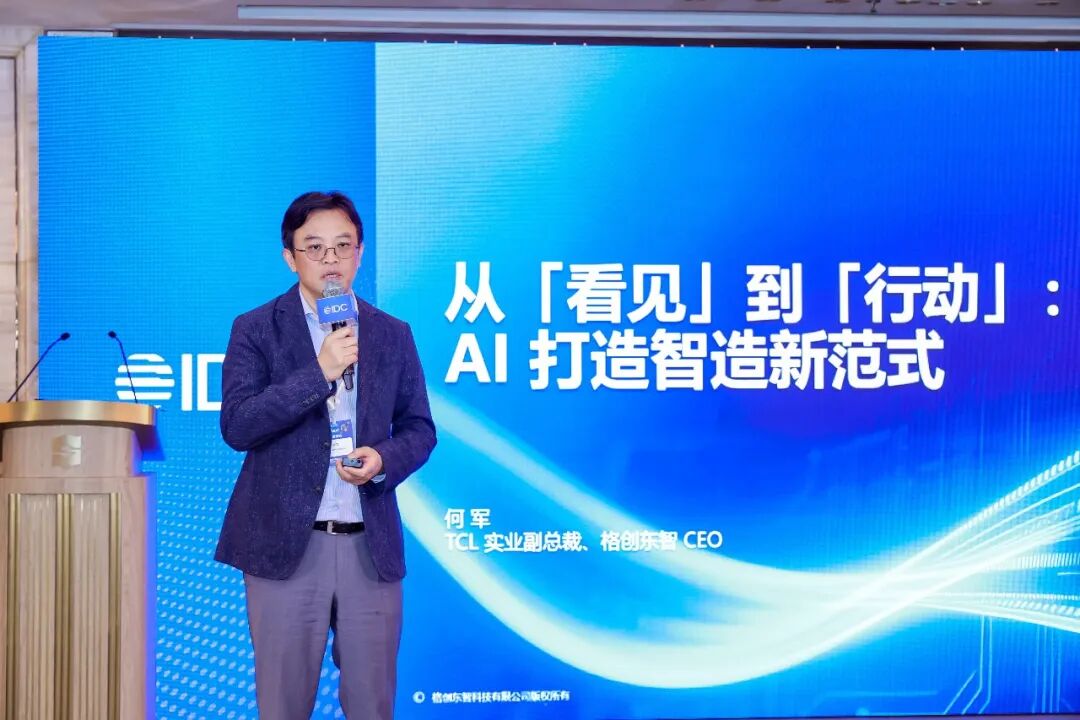
During his speech, He Jun noted that industrial scenarios have much higher requirements for certainty, safety, real-time capability, and traceability than general office scenarios. A wrong parameter adjustment could directly cause yield loss and downtime risks. This is why many agents perform well in customer service and office settings but struggle to truly enter the main production chain.
To solve this "last mile" problem of industrial AI, Gtrontec proposed the industrial version of Harness Engineering. Centered on the OctoMind Agentic AI platform, it achieves a closed loop from analysis to execution through four dimensions: enterprise context access, dual-mode dual-track dual-know-how, agent collaboration engineering, and industrial-grade operation and maintenance safety. He Jun used examples of process optimization and equipment control in the semiconductor industry to explain how contextual semantics and atomic system capabilities enable AI to cross boundaries between IT, OT, and equipment layers, achieving precise decision-making and autonomous execution.
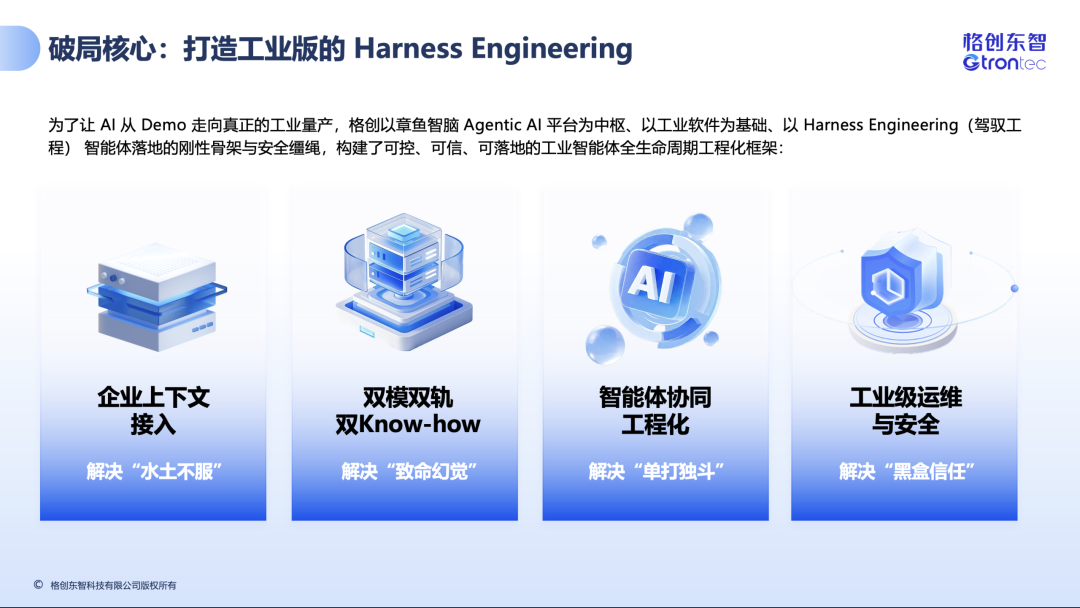
In the dual-mode dual-track practice, large models handle semantic understanding, task decomposition, and decision scheduling, while small models and industrial mechanism models handle high-certainty execution. He Jun emphasized that this collaboration between large and small models is the core mechanism for achieving reliability and stability in high-risk industrial AI scenarios. Meanwhile, in agent collaboration engineering, Gtrontec adopts strategies of balanced human-machine collaboration and multi-agent orchestration, ensuring "human-in-the-loop" at critical points to optimize efficiency and accuracy in complex businesses and core decisions. In terms of industrial-grade safety and O&M, Gtrontec achieves controllable deployment of industrial-grade AI closed-loop decisions on high-value equipment through sandbox simulation, permission levels, and full-chain observability.
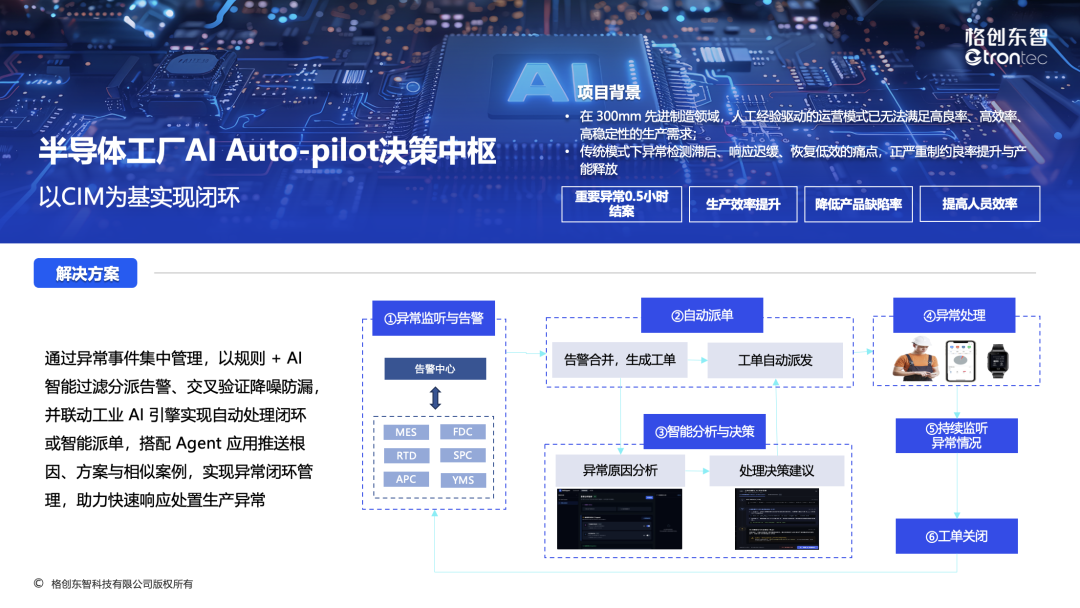
This engineering approach is generating real value on the manufacturing floor. The semiconductor AI Auto-Pilot decision hub case shown at the conference demonstrated that through collaboration between agents and CIM systems, production anomaly handling evolved from "manual experience-driven" to "autonomous closed-loop processing," reducing critical anomaly resolution time to 0.5 hours and effectively improving production efficiency and personnel utilization.
Notably, He Jun sent a clear signal to attending CIOs: the core of industrial AI competition is no longer just model capability, but who can accumulate long-term reusable industrial knowledge assets. He Jun emphasized that in the future, the biggest AI barrier for manufacturing enterprises will not be model parameters, but the internal experience, processes, and tacit knowledge precipitated in reusable Skills, graphs, and other forms.
This view is increasingly being validated by leading enterprises. Recently, a top Chinese agricultural enterprise served by Gtrontec won the "2026 IDC China Future AI Industrial Innovation Pioneer" award for its AI intelligent production scheduling agent system, marking the true commercial value of AI in complex production resource scheduling.
It is worth mentioning that Gtrontec has implemented hundreds of AI or agent closed-loop execution projects in multiple industrial scenarios across the pan-semiconductor industry, significantly improving customer production efficiency and decision accuracy. Additionally, the company strengthens reusable end-to-end industrial AI service capabilities through the OctoMind intelligent decision hub and multi-scenario agent clusters, providing a fast replication path for different enterprises' industrial AI needs.
For the many CIOs present, He Jun's speech resonated because it no longer discussed "whether AI can be done," but "how enterprises can build truly sustainable industrial AI capabilities." From system legacy transformation and industrial knowledge assetization to agent collaborative governance, manufacturing AI is entering deep waters. This transformation from "seeing" to "action" means that AI competition in Chinese manufacturing is truly entering the core productivity reconstruction phase.
This speech, based on field practice, not only presented Gtrontec's industrial AI landscape but also provided CIOs with actionable strategies: from data and knowledge governance, system transformation, to agent collaboration and security O&M, industrial AI is accelerating the digital transformation and autonomous governance of manufacturing enterprises with "action capability" at its core.