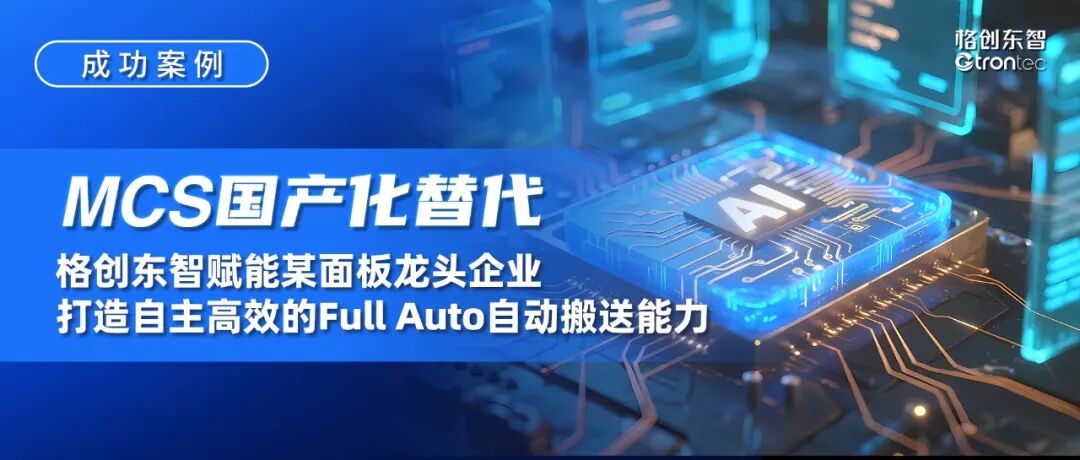
Success Case | MCS Localization Replacement: Gtrontec Empowers a Leading Panel Enterprise to Build an Autonomous and Efficient Full Auto Transfer Capability
In semiconductor display manufacturing, the MCS material handling system acts as the artery of factory operations, undertaking key functions such as material dispatch, path allocation, and transfer scheduling, directly affecting production line utilization and efficiency. As panel lines evolve toward high-generation, high-capacity, and fully automated operations, enterprises have raised higher requirements for the system's autonomy, rapid response, and continuous iteration capabilities.
A leading panel enterprise is one of the core manufacturing bases in China's semiconductor display field, operating multiple high-generation panel lines with annual capacity ranking among the industry's top. As factory capacity continues to ramp up and business complexity increases, the limitations of the original MCS systems provided by Japan's Daifuku (DFK) and Applied Materials have become increasingly apparent in terms of maintenance costs, service response speed, and technical scalability. To achieve autonomous control of core systems, the customer formally launched the MCS localization replacement program and fully deployed Gtrontec's MCS system.
Based on this need, Gtrontec carried out in-depth cooperation with the customer, systematically advancing MCS system validation and switchover while ensuring stable production, helping the customer achieve a critical leap from reliance on imported systems to autonomous control of its core transfer system.
Before the project, the core challenges faced by the customer included:
01 Wide coverage and large equipment scale. The line involves over 1,000 transfer devices; the original system is deeply coupled with the line, and any switchover error may affect normal production cadence, requiring extremely high system compatibility and stability.
02 Deep system coupling and high implementation difficulty. The original MCS system is deeply integrated with MES and equipment control systems. The new system must not only fully replicate all original capabilities at the functional level, but also achieve comprehensive optimization and improvement in scheduling performance.
03 Strict production continuity requirements. Panel manufacturing demands extremely high line stability; the system switchover must be completed in steps without affecting on-site production, with a very limited implementation window.
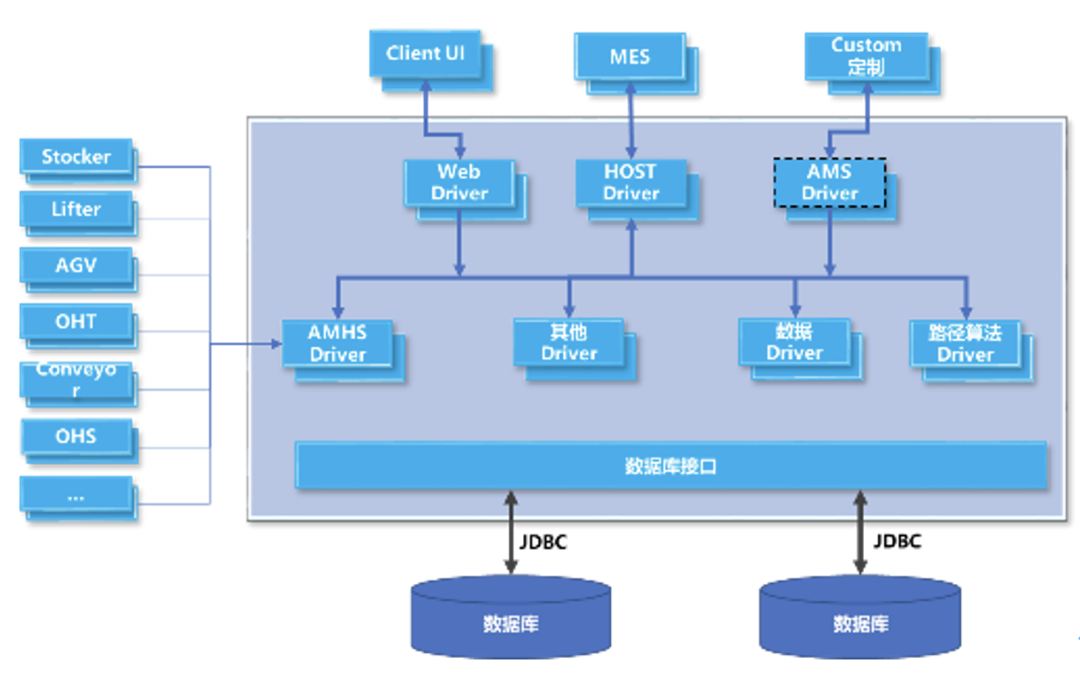
Addressing the customer's core need for MCS localization, Gtrontec provided a full-stack solution from system research, development and validation to smooth switchover, ensuring the new system is stable immediately after go-live.
Project Implementation
System Research Phase: The project team went deep into the site and, based on the actual operating logic of all transfer operations, fully mapped out normal processes, exception handling processes, and various special scenarios. On the basis of fully replicating all functions of the original system, they completed iterative optimization of scheduling algorithms.
System Development Phase: While ensuring the production line is not affected, completed full-scenario test verification for 1,000+ devices, ensuring all functions pass online testing, laying a solid foundation for stable system operation.
Before Go-Live Switchover: Without affecting on-site production, the project team connected the simulated environment to production MES dispatch tasks, simulated actual device transfer times, and continuously iterated and refined scheduling algorithms to eliminate potential risks before launch.
Official Go-Live: Adopting a zone-by-zone progressive switchover strategy, the team first completed deployment in a small area, fully observed and verified stable operation, then switched the remaining zones in sequence, ensuring a smooth transition and minimizing impact on production.
After the successful deployment of the MCS system, the project has achieved significant results in cost, efficiency, and management value:
Reduced overseas dependence, saving millions in annual O&M costs. After the new system went live, dependence on overseas original equipment manufacturer services and maintenance decreased, reducing related maintenance and upgrade costs, with estimated annual savings of over 1 million RMB.
Transfer efficiency improved by 30%. The system achieves intelligent functions such as dynamic pathfinding, load balancing, and automatic escape path switching, increasing overall transfer efficiency by 30%, providing strong support for production line capacity release.
Autonomous control of core systems. As the logistics dispatching hub of the production line, the localization replacement of MCS marks a new level of customer's autonomous control capability in core industrial software, laying a solid foundation for continuous optimization and iteration.
In the future, Gtrontec will continue to focus on logistics automation in the semiconductor display industry, driving material transfer for manufacturing enterprises from 'automation' to 'intelligence' through optimization of intelligent scheduling algorithms, multi-scenario adaptive transfer, and AI predictive maintenance, providing sustained momentum for efficient operations in the semiconductor display industry.